Quick answer:
If you have run out of heating oil, call your supplier and get a delivery scheduled first — everything else waits on fuel being in the tank. While you wait, press your burner’s red reset button once and once only, keep the house from dropping below 55°F if you can, and let cold-water faucets drip on exterior walls. Once oil is delivered, most oil burners need to be restarted and the fuel line bled before heat comes back. Supreme Oil can be reached at 914-893-4800.
Ran Out of Heating Oil in Westchester? What to Do Now
First: get fuel on the way
Everything else on this page is secondary. An oil burner cannot run without oil, and no amount of troubleshooting changes that. Call and get a delivery scheduled before you start looking at the equipment.
When you call, have three things ready. It makes the difference between a five-minute call and a twenty-minute one:
- Your address, and whether the driveway is clear. A delivery truck needs room to get in and out.
- Your tank’s size and location — basement, outside at ground level, or underground. A 275-gallon basement tank is the most common setup in Westchester, but it is not the only one.
- Roughly how long the heat has been off. This matters more than people expect, because it tells the technician whether they are looking at a simple restart or a house that needs checking for frozen pipes.
Minimum delivery sizes vary across the service area, so ask what applies at your address rather than assuming. Supreme Oil’s office can confirm it on the call.
Press reset once. Not twice.
Your burner has a red or orange reset button, usually on the burner housing itself or on the primary control box mounted to it. When a burner runs out of fuel, it tries to fire, fails, and locks itself out on purpose. The reset button clears that lockout.
Press it one time.
If the burner does not stay running, stop. Do not keep pressing it, and this is the single most important thing on this page. Each reset attempt sprays more unburned oil into the combustion chamber. Enough accumulated oil and the next successful ignition can light all of it at once — which is a genuine fire risk, not a theoretical one. It is also how a run-out turns from a delivery charge into a repair bill.
Two more cases where you should not restart at all:
- You smell oil, or there is smoke or soot around the burner. Leave it off and say so when you call.
- There is standing oil anywhere near the unit. Same answer.
While you wait, protect the house
A cold house is an inconvenience. A house with burst pipes is a five-figure problem, and the gap between the two can be a single night in January.
- Keep the thermostat set normally. Turning it up does nothing without fuel, and you want the system to come on by itself the moment oil arrives.
- Let cold-water faucets drip, particularly any served by pipes running through exterior walls, unheated crawl spaces, or an unheated garage. Moving water is much harder to freeze.
- Open the cabinet doors under kitchen and bathroom sinks on outside walls, so room air reaches the pipes.
- Close off rooms you are not using, and keep everyone in one or two rooms that hold heat best.
- Use space heaters carefully if you have them — never unattended, never near fabric, and never an extension cord.
- If the house is going to sit below about 40°F and you cannot get fuel or heat for a while, shutting off the water main and draining the system is worth considering. Ask about it on the call.
What happens after the delivery
This is the part that surprises people, and it is why the heat does not simply come back on when the truck leaves.
When a tank runs completely dry, the fuel line and the pump fill with air. Air does not burn. Most burners need to be restarted and the line bled – a technician opens a bleed valve on the pump and runs it until clean oil comes through with no bubbles – before the burner will hold a flame. Many also need the oil filter and nozzle replaced at the same time, because sediment at the very bottom of a tank is exactly what gets pulled through on the last few gallons.
Some deliveries include a restart and some are fuel only. Ask which you are getting when you book, so you are not waiting on a second visit in the cold.
How to not be here again
A run-out is almost always a scheduling failure rather than a budgeting one. The two fixes:
Automatic Delivery. Your supplier tracks how fast your home burns fuel against the weather and schedules deliveries before the tank gets low, so there is nothing to remember. With Supreme Oil, enrolment is free and there is no cancellation fee, so there is no real downside to trying it for a season.
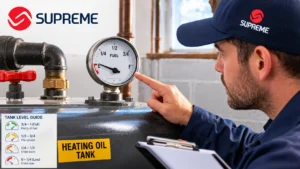
If you would rather order yourself, set a floor and treat it as non-negotiable: order at one quarter of a tank, never at one eighth. On a 275-gallon tank, a quarter gauge is roughly 60 gallons — which in a January cold snap is a week or less. That buffer is what absorbs a busy delivery schedule or a storm.
Frequently Asked Questions
Can I put diesel or kerosene in my tank in an emergency?
Off-road diesel is chemically close to home heating oil and is sometimes used as a stopgap, but it is not a decision to make on your own — it affects your fuel, your burner, and potentially your service coverage. Road diesel from a gas station is taxed differently, and putting it in a heating tank has tax implications. Call and ask before you pour anything into your tank.
How long does it take to get an emergency delivery?
It depends on the day, the weather, and where you are. A quiet October afternoon and the first hard freeze of the winter are completely different situations. Call 914-893-4800 and the office can tell you honestly where you fall in the schedule rather than guessing.
Will I be charged extra for running out?
Ask when you call. Charges vary by supplier and by whether the visit is a delivery, a restart, or both.
My tank gauge says there is oil, but I have no heat. What now?
Then fuel probably is not your problem, and gauges do stick. Check that the emergency switch has not been flipped — it looks like a light switch, usually at the top of the basement stairs or near the burner, sometimes with a red plate. Check the burner has power. If both are fine, it is a service call rather than a delivery.
Does running out of oil damage the furnace?
Running dry once, caught and restarted properly, usually does no lasting harm. The damage tends to come from what happens next — repeated reset attempts, or sediment pulled off the tank bottom clogging the filter, nozzle, and line.