Quick answer:
Your heating oil tank gauge shows how deep the oil is, not how much is left — and because the tank is a cylinder on its side, those are not the same thing. On a standard 275-gallon tank, a gauge reading one quarter is roughly 60 gallons, not 69. The practical rule: order at one quarter, never lower.
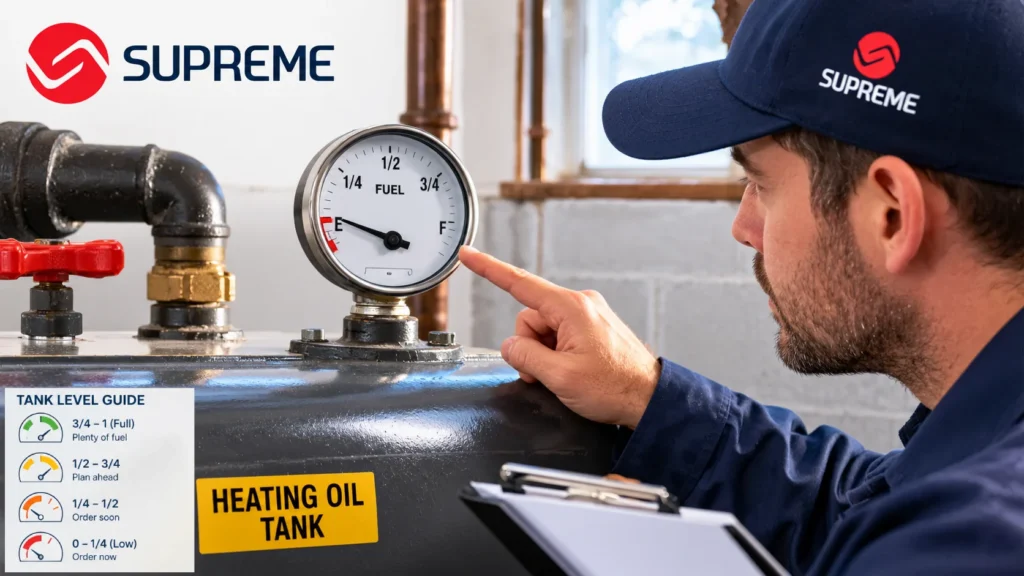
How to Read Your Heating Oil Tank Gauge
Where the gauge is and what you are looking at
On most Westchester homes the gauge sits on top of the tank, under a clear plastic dome about the size of a shot glass. Inside is a disc or a short red marker that floats on the oil, riding up and down on an arm as the level changes. The dome is usually marked F, ¾, ½, ¼ and E.
Read the top of the red disc against the markings. If the dome is clouded with age or oil film, wipe it with a rag before trusting what you see.
If the marker sits right at the bottom and has not moved in weeks, the gauge may be stuck rather than the tank empty – more on that below
The part most people get wrong
Here is the thing nobody tells you: the gauge measures depth, and your tank is a cylinder lying on its side.
Picture it. At the middle of the tank, it is at its widest, so one inch of depth holds a lot of oil. Near the bottom, the tank curves in and narrows, so one inch of depth holds much less. The gauge moves the same distance either way — but the gallons behind that movement are not the same at all.
What this means in practice:
- Half on the gauge really is half your oil. That one is honest, because the tank is symmetrical top to bottom.
- A quarter on the gauge is about a fifth of your oil, not a quarter.
- Going from half down to a quarter burns more fuel than going from a quarter down to empty. So the moment the needle passes a quarter, you have less time left than the remaining gauge travel suggests.
That last point is the whole reason people run out while still seeing something on the gauge.
Gauge reading to gallons: a 275-gallon tank
The standard tank in most Westchester basements is a 275-gallon vertical oval, roughly 27 inches deep, 44 inches tall and 60 inches long. Here is what each reading is actually worth:
| Gauge Reads | Approximate Gallons in the Tank | Roughly What That Is |
|---|---|---|
| Full (reads about ⅞) | 240–250 | A fresh delivery |
| ¾ | 215–220 | Comfortable |
| ⅝ | 175–180 | Comfortable |
| ½ | 135–140 | Start paying attention |
| ⅜ | 95–100 | Order now in deep winter |
| ¼ | 55–60 | Order. Do not wait. |
| ⅛ | 20–25 | Call today |
| E | Unknown, possibly sludge | Do not run the burner down to this |
On the numbers: these come from the geometry of a standard 275-gallon oval tank, not from a manufacturer’s chart, and real tanks vary by maker and by exactly how level they sit. Treat them as close approximations rather than exact figures. If you want certainty for your specific tank, ask your supplier — a delivery ticket showing gallons taken against the gauge reading before the fill tells you more than any chart.
And why a full tank reads ⅞: a 275-gallon tank is never filled to 275 gallons. Fuel expands as it warms, and the tank needs air space at the top, so a complete delivery leaves the gauge a little short of F. If yours reads just under full after a fill, nothing is wrong and you have not been short-changed.
Other common tank sizes
To scale the table, multiply by the ratio of your tank size. A 330-gallon tank at a quarter is around 70 gallons; a 550 at a quarter is around 115. Underground tanks often have no float gauge at all and are measured with a stick instead.
If you do not know your tank size, it is usually stamped on a plate on the end of the tank or on the leg bracket.
When to order
Order at one quarter. That is the whole rule, and it is not cautious — it is arithmetic.
A quarter tank is roughly 60 gallons. In a Westchester cold snap, a typical home burns somewhere in the range of 5 to 10 gallons a day depending on size, insulation, and how cold it actually gets. At the top of that range, 60 gallons is about six days. Six days is not much margin when a storm has every truck in the county behind schedule and you are one of forty calls.
In the shoulder months, consumption drops a lot and a quarter tank stretches much further. But if you only remember one number year-round, make it a quarter.
If your gauge is stuck
Float gauges fail, and they usually fail by sticking — which is the dangerous direction, because it shows oil you do not have.
Signs it has gone:
- The reading has not moved in weeks of cold weather.
- It reads exactly the same after a delivery as before.
- The disc sits visibly crooked in the dome.
The simplest check is a gentle tap on the dome to see if the float settles to a different position. If it does not move, or if you are not confident in the reading, stop guessing and have it looked at. A stuck gauge is a small, cheap part and a replacement is a routine job — far cheaper than the run-out it causes.
The way to stop thinking about this
All of the above is genuinely useful if you order your own oil. If you would rather not track it at all, Automatic Delivery removes the job: your supplier monitors how fast your home burns fuel against the weather and schedules deliveries before the tank gets low. With Supreme Oil, enrolment is free and there is no cancellation fee.
The gauge is still worth checking occasionally even on Automatic — it is how you catch a leak or an unusually fast burn early.
Frequently Asked Questions
How accurate are heating oil tank gauges?
As a rough indicator, reasonably good in the middle of the range. Near the top and bottom they are least reliable, and they are mechanical floats, so they stick and fail. Use the gauge to decide when to order, not to calculate exactly how many gallons you have.
What does a quarter tank mean on a 275-gallon tank?
About 55 to 60 gallons — less than the 69 gallons you would get by dividing 275 by four, because the tank narrows toward the bottom.
Why does my gauge still show a quarter when I have no heat?
Either the gauge is stuck, or the remaining oil is below the pickup line in the bottom of the tank and cannot be drawn. Either way, treat it as a run-out.
Can I check my tank with a stick instead?
On some above-ground tanks, yes — a clean measuring stick down the fill pipe gives a depth you can convert to gallons. But it needs the right chart for your tank, and on underground tanks it is a job for whoever services the tank, not a homeowner.
How often should I check the gauge?
Weekly through the heating season takes ten seconds. Monthly in the shoulder months is plenty.
Low on oil?
Call Supreme Oil at 914-893-4800 to schedule a delivery, or ask about Automatic Delivery and stop checking the gauge altogether.