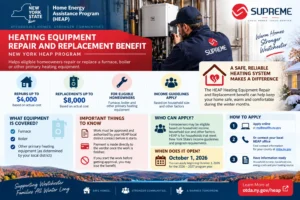
Quick answer: Replacing an oil boiler in Westchester typically runs for a standard hot-water system swap, and more where a chimney liner, asbestos abatement, near-boiler repiping or an oil tank replacement is involved. New York’s Heating Equipment Repair and Replacement benefit, scheduled to open October 1, 2026, can cover up to $8,000 for a replacement or $4,000 for a repair for eligible homeowners.
Key Takeaways
- The boiler itself is often the smaller part of the bill. Labor, venting, piping, and disposal drive the range.
- Steam systems cost more to replace than hot-water systems.
- Older Westchester homes frequently need a chimney liner or asbestos abatement discovered mid-job — ask whether your quote includes them.
- Replacing in an emergency costs more than replacing on a schedule. September and October are the cheaper months to do this.
- Eligible homeowners may get up to $8,000 toward a replacement through HEAP from October 1, 2026 — but work must be approved before it starts.
- A boiler past 20 years that needs a significant repair is usually worth replacing rather than fixing.
What you're actually paying for
The unit itself. Cast iron boilers last longer and cost more upfront. Steel is cheaper and has a shorter service life. Higher-efficiency units cost more and use less oil – whether that pays back depends on how much you burn, which you can work out from.
Steam or hot water. Steam systems are common in older Westchester housing and cost more to replace. The piping is heavier, the sizing is less forgiving, and there’s more that has to be got right.
Venting. Many older chimneys need a stainless liner to vent a modern boiler safely. This is one of the most common surprise costs on a Westchester replacement, and it’s worth asking about before you accept a quote.
Near-boiler piping. The pipework immediately around the boiler usually has to be rebuilt. On a steam system this is not optional and not quick.
Removal and disposal. An old cast iron boiler is heavy and sometimes has to be broken down to get it out of the basement.
Asbestos. Pipe insulation in homes built before the 1980s may contain asbestos. If it does, abatement is a specialist job with its own cost and can’t be skipped.
Permits and inspection. Westchester municipalities require a permit for a boiler replacement. Confirm your installer is pulling it — an unpermitted installation becomes your problem when you sell the house.
Repair or replace?
Repair usually makes sense when the boiler is under 15 years old, the fault is a single component, and it hasn’t needed work in the last couple of seasons.
Replacement usually makes sense when:
- The boiler is past 20 years and facing a significant repair
- You’ve had multiple repairs in two or three seasons
- A section is cracked or leaking — this is generally the end
- Fuel use has climbed with no change in how you heat the house
- Rooms heat unevenly and balancing hasn’t fixed it
A useful test: if the repair costs a meaningful share of a replacement and the unit is already old, you’re paying to postpone a decision rather than to solve it.
Help with the cost
New York’s Heating Equipment Repair and Replacement benefit is scheduled to open October 1, 2026. For eligible homeowners who own and live in the home, it can cover up to $4,000 for a repair or $8,000 for a replacement, based on actual cost.
Two things to get right. The work must be approved and authorized by your HEAP local district contact before it begins — starting first can cost you the benefit. And payment goes directly to the vendor once the work is complete.
Apply at myBenefits.ny.gov or contact Westchester County’s HEAP office. Confirm current dates and income guidelines with OTDA, since these change year to year.
What about a heat pump?
You may be offered one. New York has incentive programs aimed at electrifying home heating, and for some homes a heat pump is a reasonable choice. For others — older housing, limited electrical service, existing radiator systems — the conversion cost and the winter performance make it a harder call than the brochures suggest.
If you’re weighing it, get both quotes and compare total installed cost, running cost at your actual usage, and what happens in a genuine cold snap. It’s a bigger decision than replacing like for like, and it deserves more than one conversation.
When to do it
If your boiler is going to need replacing this year, do it before the cold arrives.
A planned replacement is scheduled at your convenience, quoted properly, and gives you time to compare. A replacement in January happens because you have no heat, and everything about that is more expensive — the timing, the availability, and the pressure you’re under when you sign.
September and October are the quiet months. Once the first cold week hits, replacement work queues behind no-heat emergency calls.
Frequently Asked Questions
How long does an oil boiler last?
Most give useful service for a couple of decades, depending on how well they’ve been maintained. Annual cleaning and tune-ups extend it. Once you’re past twenty years, budget for replacement rather than being surprised by it.
How long does a replacement take?
A straightforward hot-water swap is usually a day or two. Steam systems, chimney liner work or asbestos abatement add time. Ask for a schedule before the work starts.
Will a new boiler cut my oil bill?
A modern boiler burns less oil than a worn one for the same heat. How much you save depends on your usage and the condition of what you’re replacing. If you know roughly how many gallons you use per season, we can give you a realistic figure rather than a marketing one.
Do I need a permit in Westchester?
Yes, municipalities require one for a boiler replacement. Your installer should pull it. Confirm that before work begins.
Can I get help paying for it?
Eligible homeowners may qualify for New York’s Heating Equipment Repair and Replacement benefit, scheduled to open October 1, 2026 – up to $8,000 for a replacement. Approval must come before the work starts.
Should I replace my oil tank at the same time?
If the tank is old, yes. Doing both at once is cheaper than two separate jobs, and a tank failure is a far messier problem than a boiler failure.
What should be on the quote?
The boiler, labor, removal and disposal, near-boiler piping, venting or chimney liner if needed, permit, and any asbestos work. If any of those are missing, ask whether they’re excluded or simply not yet priced.