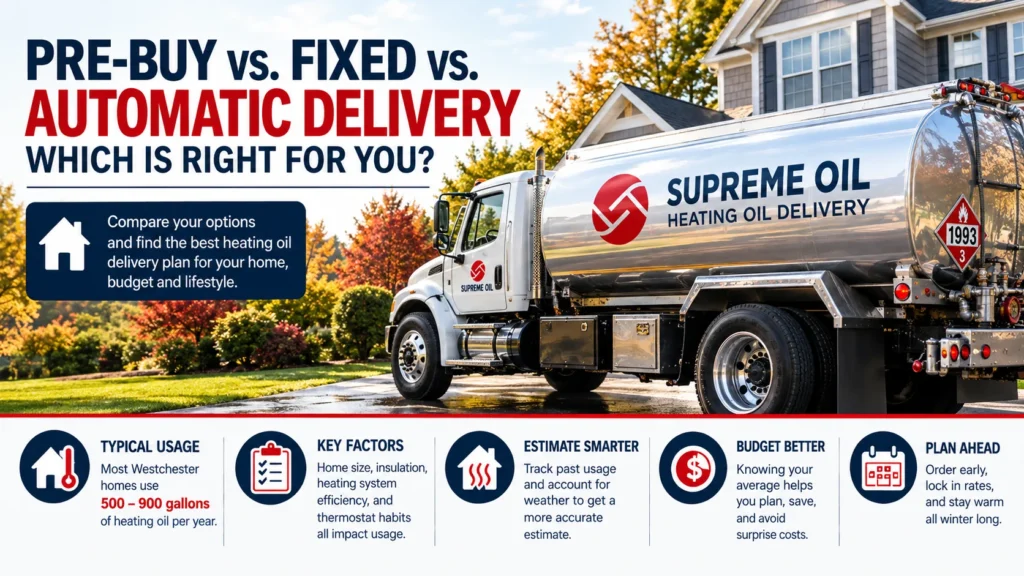
Pre-Buy vs. Fixed vs. Automatic Delivery – Which Is Right for You?
Last updated Sep. 29, 2026
|
By Supreme Oil Editorial Team
|
Published Aug. 20, 2026
|
Heating Oil
Quick answer: Pre-Buy ($ 5.46/gal) suits homeowners who want the lowest locked-in rate and are comfortable committing early. Fixed Contract ($ 5.61/gal) suits those who want price protection with more enrollment flexibility. Automatic Delivery ($ 5.81/gal) suits homeowners who prioritize simplicity over locking in a rate in advance.
Choosing a heating oil plan shouldn’t require a finance degree. Here’s a straightforward look at Supreme Oil’s three main options, so you can pick the one that actually fits how you budget and how much certainty you want.
Key Takeaways
Pre-Buy — Lowest rate ($ 5.46/gal), requires early commitment
No advance price commitment — delivery scheduled automatically based on usage
Best for: homeowners who prefer simplicity over locking in a rate
Comparison
Pre-Buy
Fixed Contract
Automatic Delivery
Current rate
$ 5.46/gal
$ 5.61/gal
$ 5.81/gal
Price locked in?
Yes, for the season
Yes, once enrolled
No — market rate
Which is cheapest?
Lowest current rate
Middle
Highest current rate
Which is most flexible?
Lowest flexibility (early enrollment)
Moderate flexibility
Most flexible — no advance decision
Best for
Lowest available rate, early planners
Balanced protection + flexibility
Simplicity, no advance decision
Delivery
Scheduled automatically
Scheduled automatically
Scheduled automatically, based on usage
All three plans include Supreme Oil’s automatic scheduled delivery – the difference is entirely in how (and when) your price per gallon is set, not in the delivery service itself.
Pre-Buy is Supreme’s lowest current rate because you’re committing early, before the season’s demand curve pushes prices up. If you know roughly what your household uses each winter (see our usage guide) and you’d rather lock in a number now than watch the market, Pre-Buy is usually the most cost-effective plan available.
Choose Pre-Buy if: you want the lowest rate available, you’re comfortable enrolling before the season starts, and predictable budgeting matters more to you than flexibility.
A Fixed Contract locks in your rate similarly to Pre-Buy, but typically allows enrollment with a bit more timing flexibility through the season. It’s a middle-ground option for households that want price protection without needing to commit as far in advance as Pre-Buy requires.
Choose Fixed if: you want protection from mid-season price increases, but you’d rather not (or can’t) commit to Pre-Buy’s earlier enrollment window.
Automatic Delivery means Supreme Oil monitors your usage and schedules deliveries so you never run low — without you locking in a rate at all. You pay the standard market rate at time of delivery. It’s the most flexible option and requires the least advance thinking, which is exactly why some households prefer it, even at a higher per-gallon rate.
Choose Automatic Delivery if: you’d rather not commit to a rate in advance, your usage is unpredictable, or you simply want the “set it and forget it” experience without evaluating pricing plans each year.
The Bottom Line - Decide in One Step
If your priority is…
Choose…
The lowest possible rate, and you can commit early
Yes. Plans can be reassessed each year with no obligation to commit long-term.
Is Automatic Delivery more expensive overall?
It depends on the season. Automatic Delivery is priced per gallon at the market rate, so total seasonal cost moves with the market rather than being fixed in advance.
Do all three plans include emergency delivery?
Contact Supreme Oil to confirm current service-level details, as this can vary by plan.
What happens if I use more or less oil than expected on Pre-Buy?
Contact Supreme Oil to discuss adjustment options. Pre-Buy terms typically address both under- and over-usage.